Instances and matches
One Instance is one gameplay session. A cell executor can host multiple Space/Cells and Instances and reclaims temporary state when matches end.
A C++20 runtime for tower defense, co-op, arenas, and dungeons. MMO is a possible product form; instances come first, with seamless-map design reserved.

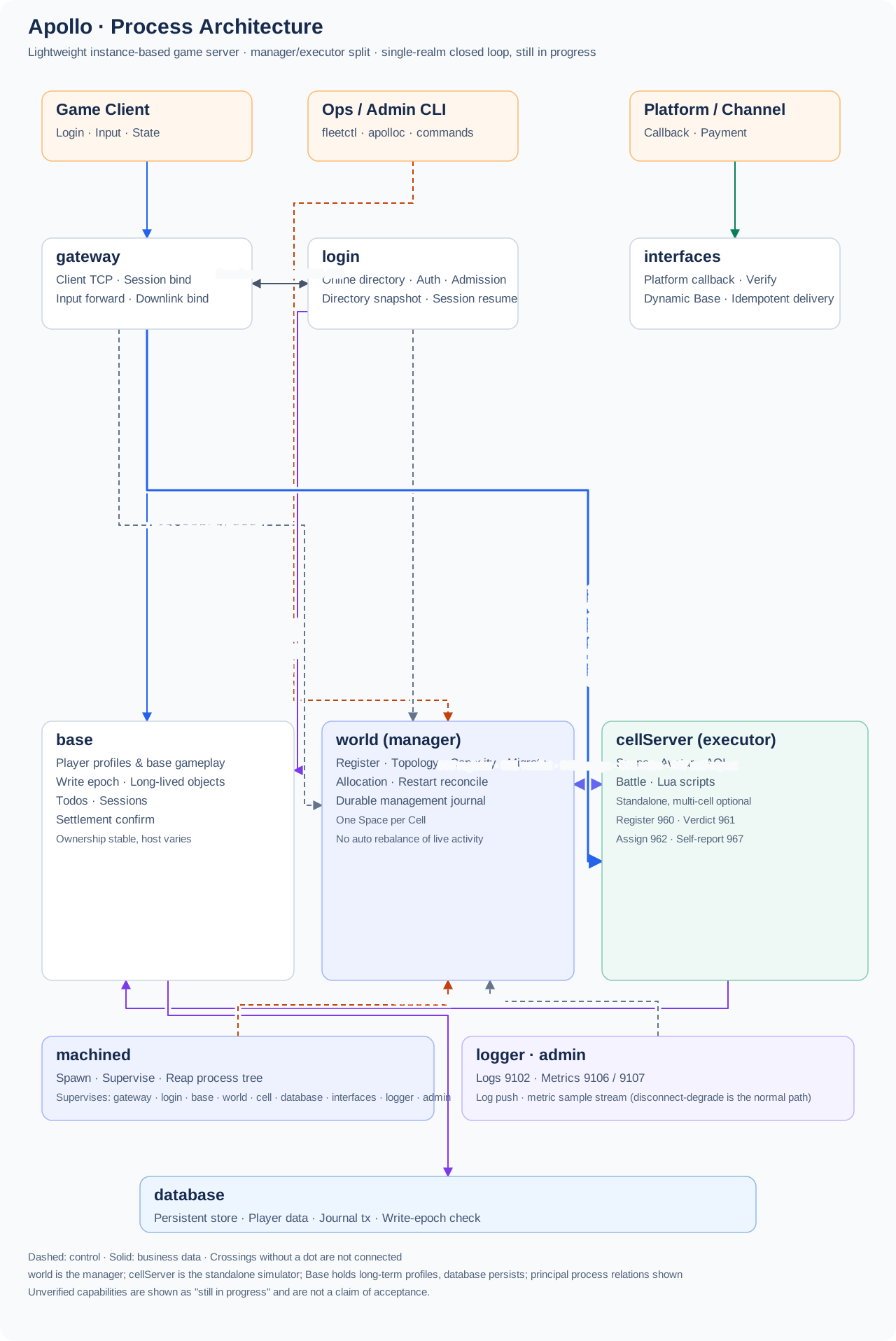
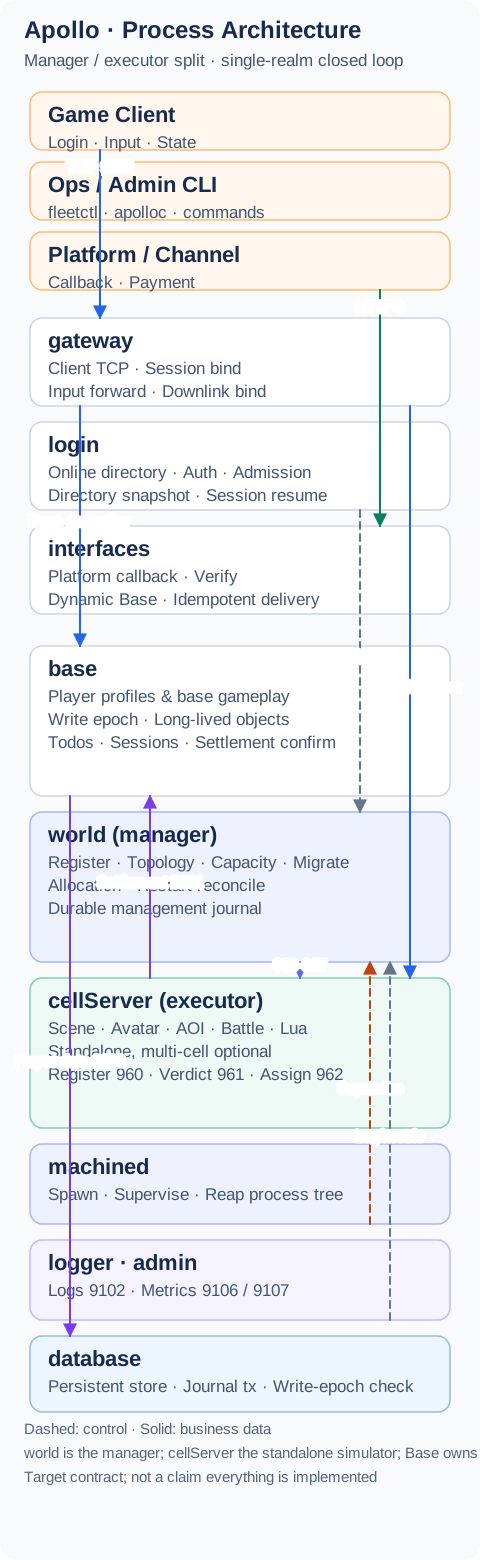
Business traffic goes directly through gateway to the owning Base or current cell. world manages placement and topology. Solid lines show business traffic; dashed lines show registration and management.
Optional interfaces receives payment/channel callbacks over HTTP/HTTPS. Durable intake precedes asynchronous delivery to the current Base, resolved by stable player identity. Base validates and fulfills through database. Gameplay WS/WSS belongs to the gateway game-message path — TCP/WS/WSS share one accepted path — and never enters the HTTP handler.
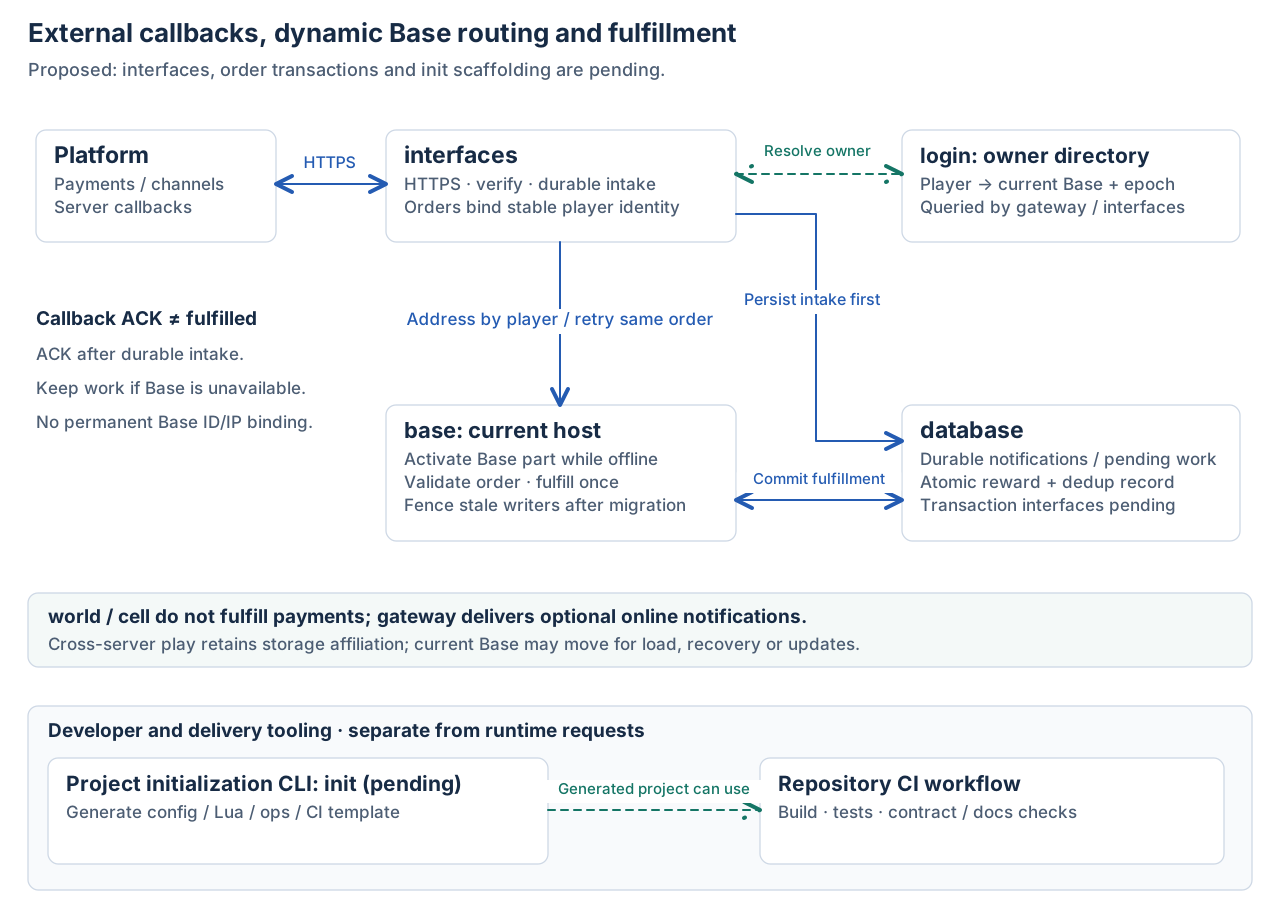
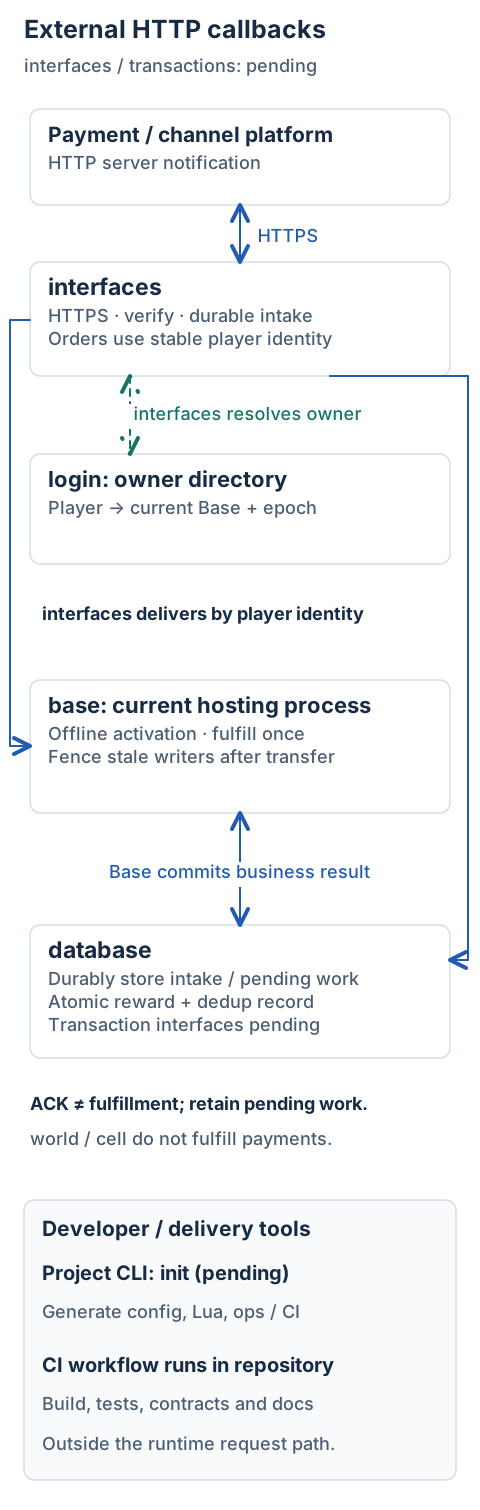
Implementation status: the gateway game TCP/WS/WSS entries are accepted (including WSS certificate-chain/hostname rejection and key-configuration negatives); the interfaces intake chain (byte-exact raw-request retention, request-timeout and queue budgets, bounded single-writer), the order transaction domain (durable intake and pending work, epoch-based current-Base resolution, atomic fulfillment dedup credentials), and the apolloc init scaffolding are implemented with test coverage; the channel verification executor and inter-process wiring (interfaces→order intake, base write-authority lifecycle, reward apply executor) remain planned. See the Mistlane/FOGS review; root todo.md tracks implementation.
Apollo is a lightweight instance-based multiplayer game server engine for tower defense, co-op PvE/PvP, arenas, and dungeons. MMO describes a possible product scale or form, not the server architecture. Seamless maps are deferred, with multiple Cells per Space, neighboring visibility, and authority handoff reserved.
The target-role model routes client base gameplay and simulation separately through gateway. Base loads/saves through database, login hosts authentication/directories, and machined optionally supervises local processes. Scene transfer retains Base/storage affiliation.
| Topic | Document |
|---|---|
| Target architecture | Architecture Overview |
| Target names and boundaries | Concepts and Names |
| Current executable prototypes | Server Applications |
| World and cross-server transfer | Instance-Based GameServer Design |
| Building the code | Build Guide |
| BigWorld–Apollo correspondence | Roles, concepts, and code mapping |
| External engine comparisons | MMO Framework Comparison |
External BaseApp/CellApp names retain their real meanings. Apollo uses base for persistent-player gameplay and world for Space/Cell management and cell for simulation; see the target-role glossary.