
Architecture Overview
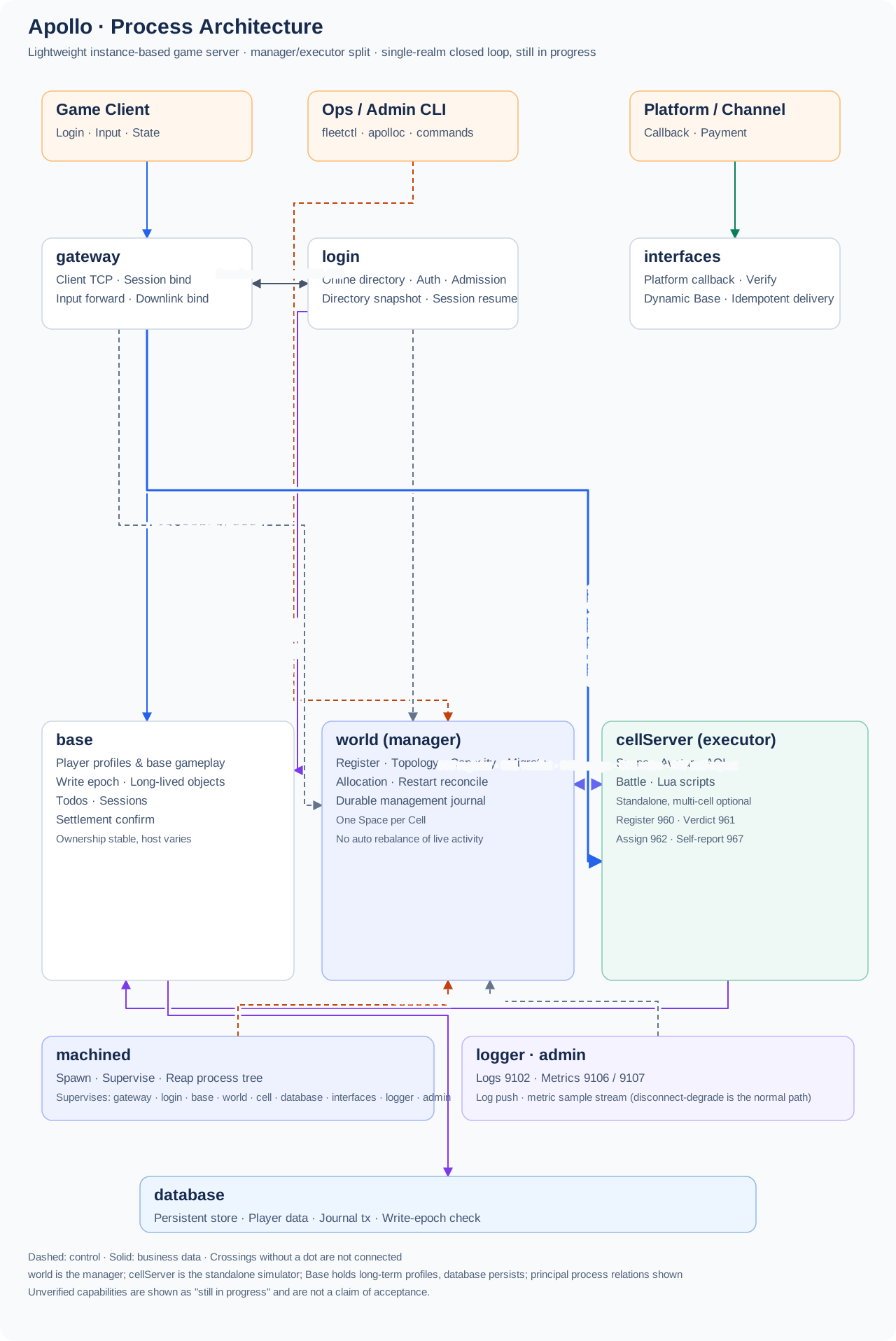
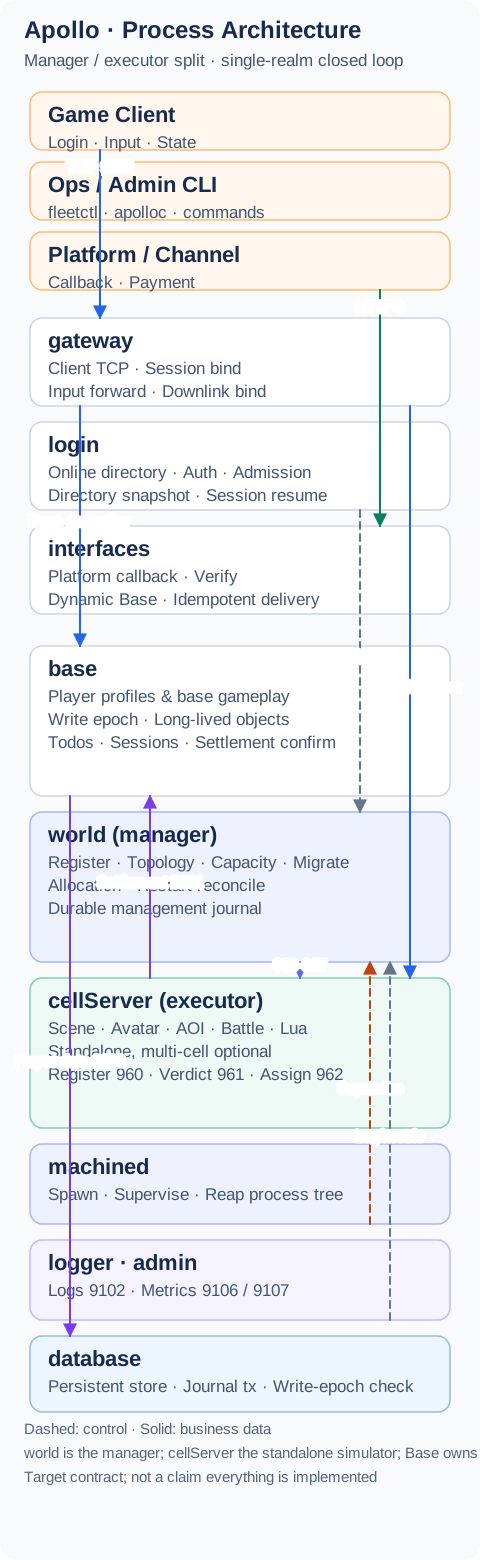
Keep gateway, loginServer, baseServer, worldServer, database, and machined. Use the discussed cell executor: worldServer overlaps CellAppMgr management and cell overlaps CellApp execution. Base owns persistent objects and saves through database.
Space corresponds to existing Scene spatial semantics, Cell is a partition, and Instance is a temporary gameplay lifecycle. Initially one executor and one Cell per Space; reserve multiple Cells per Space. Seamless splitting, Ghosts, and cross-boundary combat remain unimplemented.
Executors register with World, which manages topology/migration. loginServer hosts service/online location projections; gateway forwards directly to Base/cell. machined supervises locally and is optional beside independently deployed World/cell. Cross-server play retains home Base/storage affiliation without moving complete profiles.
Protocol replacement separately transfers Base objects, cell simulation, and World management state before switching authority/routes. Code-only updates preserve wire and may update Lua; C++ uses replacement processes. Validate TCP, sessions, and complete activity continuity separately.
Temporary instance lifecycle
Group request → Base validation → World Space/Cell placement → cell creates/runs Instance → original Base/database durable settlement → departure/cleanup. Reuse eight states; persistent Spaces need no temporary Instance.
Reading
- BigWorld–Apollo mapping: original terms, roles, code types, and gaps.
- Architecture, player objects, cross-server play, and updates.
- Applications: current WorldApp combines management/execution; Base/database prototypes exist; cell entry and full wiring remain pending. Track implementation in root todo.md.
Preserve external-engine source names without treating them as another Apollo topology.