Control plane and agent collaboration
The Server owns permissions, approvals, audit, configuration and function routing; Agents connect game services and node capabilities through a unified session transport.
Distributed game operations control plane and agent collaboration platform

Croupier is an operations control plane for one company with multiple games and environments. The Server owns governance, contracts, pages and routing. A sidecar connects game SDKs; capture, synthetics and devops Agents provide distinct capabilities. Analytics runs through a separate pipeline.
 Login
The console uses HTTP/SSE. Agents establish outbound TCP sessions; SDKs connect to the sidecar gateway. Multi-instance deployments forward requests to the Server that owns the live Agent connection. The diagram separates processes, storage and optional deployment components.
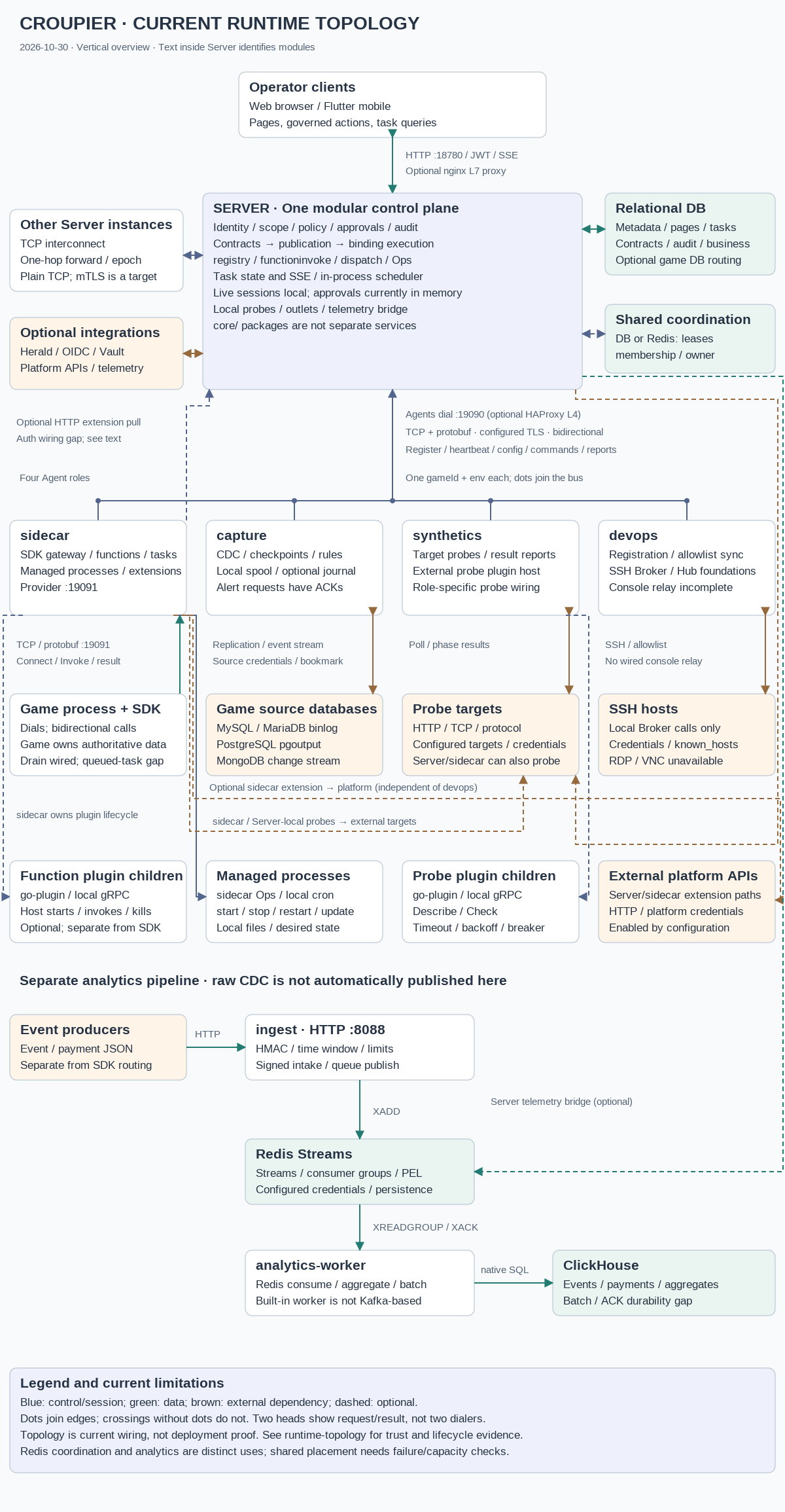
Runtime connections and lifecycles / 逐条连接与生命周期
Explore the current architecture, state ownership and limitations →
TLS is configuration-dependent and disabled in development templates. Cluster interconnect relies on trusted network isolation; production approval wiring still uses memory storage. HA routing does not imply HA for every business state.
Authorization is based on a Casbin RBAC/ABAC hybrid model — beyond roles, requests can be allowed or denied by attributes. Policies are two-layer: YAML provides defaults, and database override policies tune them online. Operations carry low / medium / high / critical risk levels; high-risk operations automatically enter the approval flow, and dual-approval rules require multiple confirmations before release.
game_idenv expresses logical environments such as dev/test/staging/prodscope expresses business ownership, target expresses runtime locationAudit follows execution paths and policy. Hash-chain validation covers hashed fields; it is not immutable storage or a guarantee that every operation is recorded. Execution logs, telemetry and audit serve different purposes, with masking rules applied by their respective paths.
# Clone the repository
git clone https://github.com/cuihairu/croupier.git
cd croupier

# Download dependencies
go mod download

# Build the services
make build# Start the Server
./bin/croupier-server --config configs/server.yaml
# Start the Agent (local dev: connect to localhost; docker-compose deployments use configs/agent.yaml instead)
./bin/croupier-agent --config configs/agent.local.yaml# Check Server health
curl http://localhost:18780/healthz
# Inspect API meta information (version / capability declarations)
curl http://localhost:18780/api/v1/Organized by usage path:
| Path | Entry | Description |
|---|---|---|
| Quick Start | Guide · Guide | Installation, configuration, Server + Agent startup, minimal loop |
| Page product | Function management · Page Studio · Resource Catalog | Register functions → pages generated automatically → publish via Proposal Inbox → controlled execution in Console |
| SDK | SDK overview | Provider / Invoker / configuration / capability matrix, 6 languages |
| API | API reference | REST contracts, authentication, game/env scope, per-resource APIs |
| Operations | Operations · Analytics | Deployment, monitoring, backup, analysis, troubleshooting |
| Development | Architecture | Architecture, code conventions, extension strategy, release rules |
Historical design and migration documents live under Architecture — proposals and migrations (collapsed in the sidebar) and are not part of the main onboarding path.
Apache-2.0 License