
Current architecture
Latest review, 2026-10-30: CHANGES REQUIRED. Schedule claims now precede dispatch and entry points use Govern; run-row and descriptor failures block dispatch. Reproduced gaps remain in function ACLs, risk lookup, expired claims across slots, and partially persisted terminal events. Drain/shutdown normal paths exist, but accepted-task and overall deadline guarantees remain incomplete. See the latest review. High-risk production writes are not approved.
Croupier is a game operations control plane for one company with multiple games and environments. The implementation combines a modular Server, outbound Agents with distinct roles, and game SDKs, plus a separate analytics pipeline. This overview follows source wiring reviewed on 2026-10-30; design goals are not implied runtime guarantees.
System diagram
Arrows identify the labeled flow or connection initiator. Agents dial the Server and SDKs dial the sidecar; established sessions carry requests and results in both directions. Dashed edges are optional connections, including cluster coordination. L7/L4 proxies are deployment options; a single instance may be reached directly.
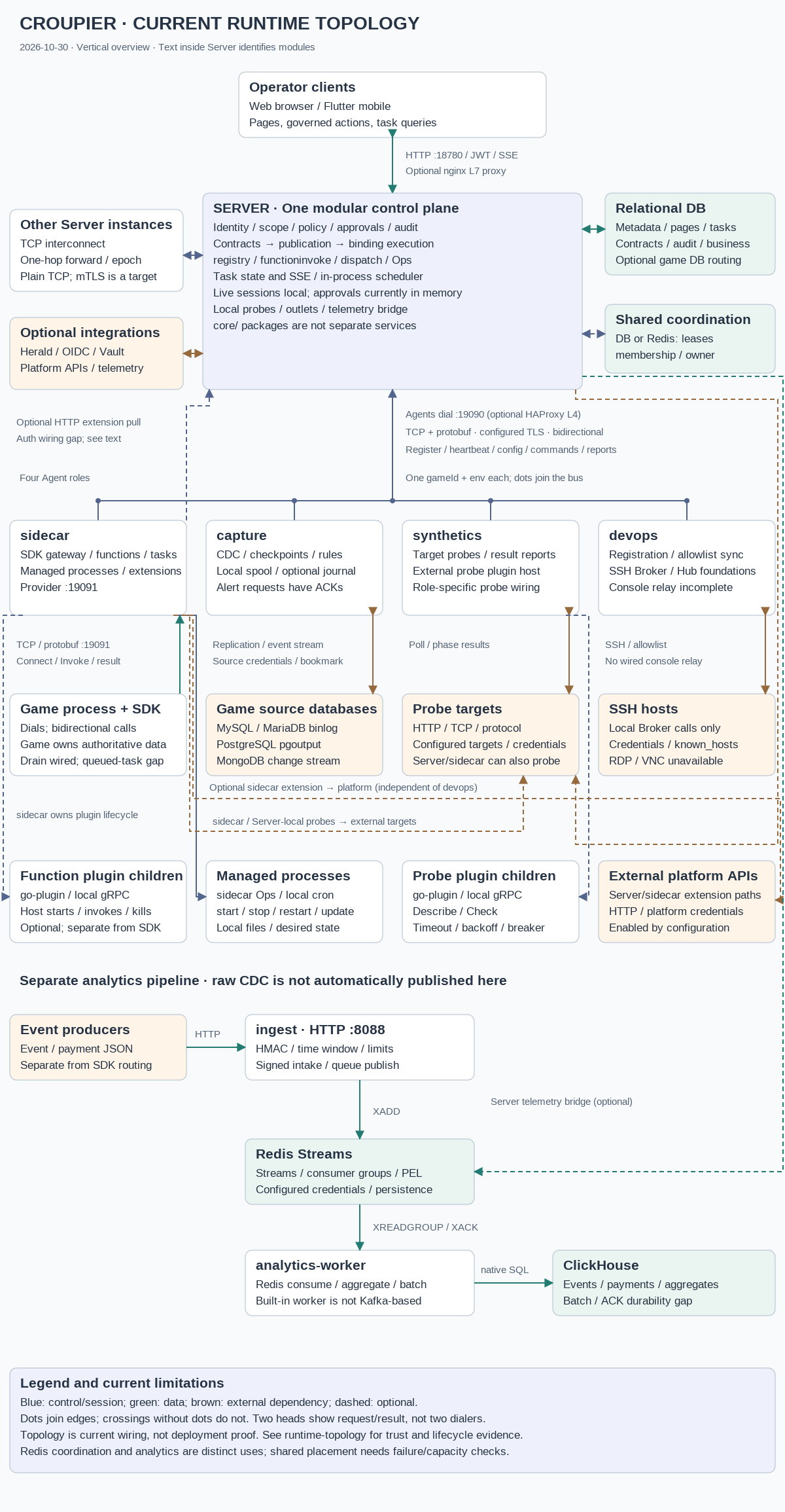
Processes and responsibilities
| Component | Current responsibility | Boundary |
|---|---|---|
| Web console | React/Umi/Ant Design, resources, Page Studio and operator actions | HTTP API/SSE; no direct Agent sessions |
| Server | Gin API, identity, scope, policy, approvals, audit, contracts, pages, registry/dispatch and Ops | One modular deployment unit |
| sidecar-agent | SDK provider sessions, game function dispatch, tasks and managed process/plugin wiring | Built as croupier-agent; some wiring remains in internal/app/agent |
| capture-agent | Database change capture, checkpoints, filtering and rules | Separate from SDK function routing |
| synthetics-agent | Role-specific probes, results and probe plugins | Role-specific application lifecycle |
| devops-agent | Registration, allowlist sync, Broker/Hub session foundations | Console-to-Agent relay is incomplete; RDP/VNC unavailable |
| ingest / analytics-worker | Event publishing, consumption and ClickHouse aggregation | Built-in worker consumes Redis Streams; Kafka publishing alone is not an end-to-end pipeline |
Execution and publication
- HTTP authentication and scope middleware resolve and authorize gameId + env.
- Console execution checks the selected PageSpec snapshot and binding. Function calls converge in internal/platform/functioninvoke.
- Disabled/assignment gates, policy, approval and input-contract checks run before dispatch as applicable.
- Dispatch selects a scoped Agent, using its local session or forwarding to the Server instance that owns that session.
- The sidecar invokes the game SDK over its provider session. task_runs/task_events persist asynchronous progress for queries and SSE.
- Audit is recorded according to the relevant path and policy. Execution logs are a separate mechanism, not an audit transaction guarantee.
Publication follows registration/OpenAPI → FunctionContract → resource semantics → proposal/draft → validation and publication → Console binding execution. The Console uses published snapshots; Page Studio also has a controlled draft execution path. Database-backed page idempotency does not make all external side effects exactly-once.
State and availability
| State | Current location | Implication |
|---|---|---|
| Live Agent/SDK connections | Owning process memory | Access through owner forwarding, not shared net.Conn |
| Registry | Local registry and database agent_sessions snapshots | Discovery snapshots do not replace live sessions |
| Membership and owner leases | Shared relational database or configured Redis | One-hop forwarding and epoch fencing |
| Business data, pages, tasks and page idempotency | Relational database; some game models support dbctx routing | Verify scope behavior for each model |
| Task routing | Local cache/file with task_runs lookup fallback | Cross-instance cancellation has a database fallback |
| Function approvals | ApprovalsStore backed by SQLStore | Approval state survives restarts and is shared across instances |
| Audit | SQLAuditStore and AuditService | Hash-chain validation; no signer wired by default |
| Analytics | Redis Streams → worker → ClickHouse | Separate from the control database |
HA routing exists, but not every business module has shared state. Some cluster initialization failures fall back to standalone; healthz does not fully represent cluster readiness.
Transport and trust
- Server HTTP: 18780 by default; HTTPS commonly terminates at the reverse proxy.
- Agents dial Server control on 19090. SDKs dial the sidecar provider on 19091. Ports are configurable.
- Custom TCP sessions use length-prefixed framing and protobuf platform messages; function payloads are typically UTF-8 JSON.
- core/transport/tcp owns MuxConn. Roles explicitly compose registration, reconnect and configuration packages.
- Agent-to-Server TLS is supported but disabled in repository development templates: Server cert/key are empty and Agent insecure=true. Configure certificates explicitly for production.
- Server interconnect supports mTLS via
cluster.interconnectTls(peer-certificate identity: dual EKU server role, Agent certs rejected; unhandshaked forward rejected). When the cluster is enabled but the certificate surface is unset and TLS verification is skipped, startup fails closed unlesscluster.allowPlaintextInterconnect: trueexplicitly confirms a trusted isolated network.
Scope and databases
The authorization scope is gameId + env. Targets, Agents and nodes describe execution placement. Each Agent instance declares one scope.
Single-database mode still validates scope. multiGame separates metadata from selected game models through dbctx. Binding validation and physical database-name calculation currently follow separate paths: verify mappings before changing prefixes or migrating legacy database names. A logical environment does not automatically imply dedicated hardware, a cluster or a database.
Source map
| Concern | Repository paths |
|---|---|
| Bootstrap | cmd/server/root.go, cmd/server/cluster.go, internal/svc/service_context.go |
| API and scope | internal/handler/routes.go, internal/svc/game_middleware.go |
| Execution | internal/platform/functioninvoke, internal/platform/dispatch |
| Registry and clustering | internal/platform/registry, internal/cluster |
| Pages | internal/dashboard, internal/api/page, internal/api/console |
| Governance | internal/platform/approvals, internal/audit |
| Storage | internal/db/router, internal/db/dbctx |
| Agents | agents, core, internal/app/agent, cmd/*-agent |
| Analytics | cmd/ingest, cmd/analytics-worker, internal/analytics |
| Simulated integrator | sdks/go/cmd/demo-game (design: ../design/demo-game) |
Reading path
- ADR 0001: Transport selection
- ADR 0002: Game data authority and the unified target reference
- SDK wire protocol
- Transport glossary
- Session lifecycle
- Multi-instance HA and limitations
- Agent roles
- Analytics
- Quick start
Runtime evidence and lifecycles
Process inventory, connection matrix, lifecycle SVGs, deployment failures and official-reference checks. Diagrams show current wiring; approval persistence is wired (SQLStore with CAS, 9066d7c10); interconnect mTLS, Provider draining and reliable task replay remain follow-up work.